Of the students we surveyed, 57 percent had already enrolled to study abroad. Still, they called themselves only somewhat confident about navigating a new culture. Acceptance letter in hand. Program dates set. Yet they were not sure they belonged there.
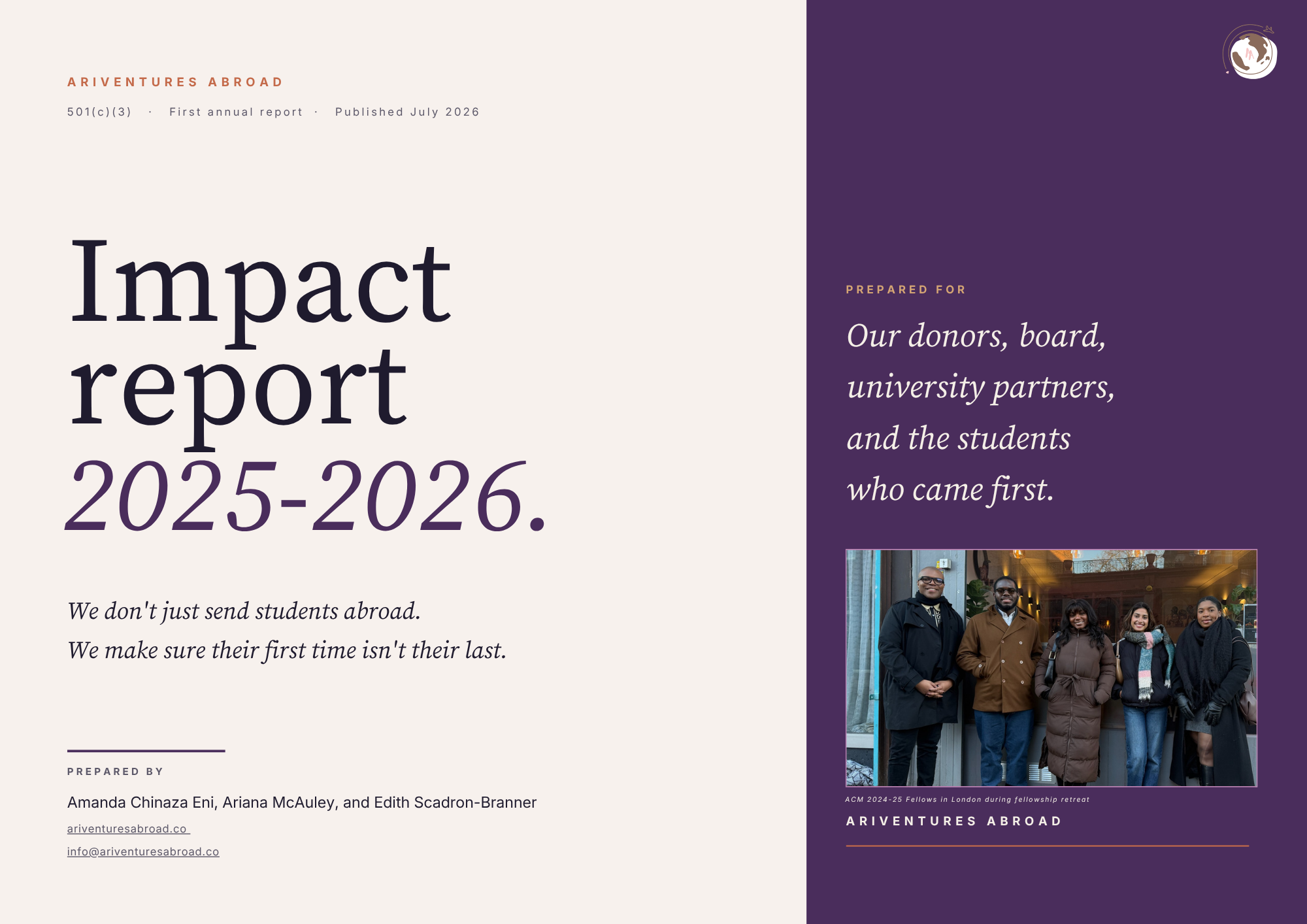
That number sits near the center of our first study abroad impact report. We published it in July 2026, and it is now live on our site. In short: 15 pages, two years of work, every figure checkable.
Here is what is inside, including the parts that are small.
Two years, five Fellows, three continents
Ariventures Abroad launched in 2024. Since then, we have funded five Ambrose Conrad McAuley Fellows across two cohorts. We also delivered more than 15 Global Ready Workshops in the 2025-26 school year alone. Those workshops reached roughly 150 students across five university partners. In addition, we completed a pilot mentorship cohort with three students. They came from Princeton University, the College of William & Mary, and Université Lumière de Bujumbura.
Total awards distributed in 2025: $4,000, at $2,000 per Fellow.
I will not inflate those dollars. They are modest. Still, the terms they funded were full ones. Two graduate students completed academic programs in Cairo and San José. Meanwhile, about 150 undergraduates sat in a room where somebody answered the questions they were embarrassed to ask.
The three gaps our study abroad impact report measures
Every Ariventures Abroad program answers at least one of three barriers. Each one stands between an American student and a first global experience. To measure them, we ran a pre-departure survey with the University of North Carolina at Chapel Hill Thailand cohort.
First, cost. Of students surveyed, 43 percent said scholarships or fellowships are essential to studying abroad at all. Essential is the word the survey used.
Second, prep. Only 9 percent called themselves very familiar with financial planning for study abroad. Similarly, barely one in five felt confident about the visa process.
Third, mindset. That is the 57 percent above, measured among students who had already committed to go.
Cost and prep are the gaps most programs work on. However, mindset is the gap that decides whether a student ever applies. Because of that, it is the gap Ariventures Abroad was built around.
Where the workshops landed
Global Ready Workshops run three hours. They cover funding and budgeting, visas and logistics, identity and anti-bias, and cross-cultural adjustment. They also cover mental wellness abroad, sustainable travel, and international career pathways. This year, East Carolina University and the University of North Carolina at Chapel Hill hosted sessions.
One participant in the UNC Chapel Hill Thailand cohort said it plainly. “I was able to talk to the rest of my cohort through the practice scenarios and start building community.” In that same spring 2026 pilot, every respondent agreed on one point. The session increased their readiness to participate respectfully in the host country.
Aisha, an assistant director of undergraduate business programs at East Carolina University, named the partner view directly. “This was more than a workshop. It was a call to dream bigger and think globally.”
Where the 2025-26 Fellows studied
Mykia spent her Fellowship at the University for Peace in San José, Costa Rica. There she worked in indigenous science, peace studies, and environmental justice. Afterward, she told us what shifted. “I find myself embracing authentic opportunities to collaborate and communicate with my peers in ways that celebrate diversity.”
Lauren studied Middle East policy, displaced persons, and peacebuilding at The American University in Cairo. Her advice to whoever comes next is direct. “Travel as much as you can, and speak to people in the local language, even if you’re not fluent.”
Both Fellows follow our 2024-25 cohort. Khadijah studied at Johns Hopkins University SAIS Europe in Bologna. Jamie-Lukas went to Queen’s University Belfast, and Kenneth to the Guildford School of Acting in Surrey. Notably, every one of the five has volunteered to mentor the next cohort.
What $3,455 paid for
Individual donors gave $3,455 in cash in 2025. All of it went to programs and the tools that deliver them. Specifically: $2,000 went to ACM Fellowships, or 58 percent. Workshop delivery took $1,000, and program delivery tools took $455.
Donor dollars covered half of the $4,000 awarded this cycle. Meanwhile, pro bono space, professional services, and volunteer hours carried the operational load.
The full allocation sits on page 11 of the study abroad impact report. We printed it because year-one and year-two donors have earned that transparency.
What we are committing to by 2028
Finally, the study abroad impact report closes with four public commitments for 2026 through 2028.
- 5+ ACM Fellows funded annually.
- 500+ students reached per year, across 10+ institutions.
- $50,000 in awards distributed by 2028, on a staircase of $15,000 in 2026 and $30,000 in 2027.
- 5+ institutional partnerships, plus a three-year longitudinal impact report published by 2028.
Those are numbers you can hold us to. That is why they are in print rather than in a planning document.
Read the report
We don’t just send students abroad. We make sure their first time isn’t their last. Two cohorts in, we can start showing our work on that promise. So far: two graduate programs completed, 15 workshops delivered, and five Fellows funded.
